
Automatic vs Quartz vs Mechanical Watches
Quick answer: Automatic and mechanical watches are both powered by hand-wound or self-winding springs and require no battery, while quartz watches run on a battery and a vibrating quartz crystal for near-perfect accuracy. Automatics offer the best balance of low maintenance and traditional watchmaking craft; mechanical (hand-wound) watches offer the purest connection to horological tradition; quartz offers the most accuracy and the lowest cost of ownership. The right choice depends on how much you value precision, tradition, and daily convenience.
Shop All Watches at Lexor Miami →
A Brief History of Watch Movements
Mechanical watchmaking dates back to the 16th and 17th centuries, when portable spring-driven clocks first shrank down into pocket watches. For nearly 400 years, every watch on Earth was mechanical — powered by a hand-wound mainspring and regulated by an escapement. The automatic (self-winding) movement arrived in the early 20th century, popularized by brands experimenting with rotor systems that could wind the mainspring using the natural motion of the wearer's wrist, eliminating the need for daily winding.
Everything changed in 1969, when Seiko released the Astron, the world's first quartz wristwatch. Quartz movements were dramatically more accurate and far cheaper to produce than mechanical calibers, triggering what the watch industry still calls the "Quartz Crisis" — a period through the 1970s and 80s when Swiss mechanical watchmaking nearly collapsed under competition from inexpensive, ultra-precise quartz watches from Japan.
Mechanical and automatic watchmaking survived by repositioning around craftsmanship, heritage, and status rather than pure accuracy — which is exactly why, today, a $500 quartz watch can be more accurate than a $50,000 automatic, yet the automatic remains more prestigious and collectible. Understanding that history helps explain why all three movement types still coexist today, each serving a different kind of buyer.
[IMAGE PENDING: historical/vintage open mechanical movement — no matching product photo in the current catalog pull; can source a lifestyle/heritage stock image or skip]
What Is a Quartz Watch?
A quartz watch uses a battery to send an electrical current through a small quartz crystal, which vibrates at a precise frequency (32,768 times per second). A circuit counts those vibrations to drive the watch hands with extreme accuracy — typically within 15 seconds per month, far more precise than any mechanical movement.
How it works: Battery → electrical current → quartz crystal vibration → circuit → stepper motor → hands move.
Pros:
- Most accurate movement type available
- Low maintenance — no winding, no servicing every few years
- Typically the most affordable watches on the market
- Reliable even after sitting unworn for months
- Lightweight movement, often thinner cases
Cons:
- Requires battery replacement every 1–3 years
- Seen by collectors as less "artisanal" than mechanical movements
- Second hand moves in a tick rather than a smooth sweep (in most models)
- Battery and circuit are disposable components, not something you can have serviced and passed down indefinitely
Notable quartz calibers: Not all quartz movements are created equal. Entry-level quartz movements are simple three-hand calibers, but high-accuracy quartz movements — like Bulova's Precisionist and UHF (Ultra High Frequency) calibers, which vibrate at up to 262,144 times per second — push accuracy down to around 10 seconds per year, rivaling even chronometer-certified mechanical movements. Some Swiss brands also produce thermocompensated quartz movements for even tighter tolerances, used in instruments and professional dive watches where reliability is critical.
Best for: buyers who want a dependable daily watch, first-time watch buyers, anyone who wants precision without a maintenance routine.
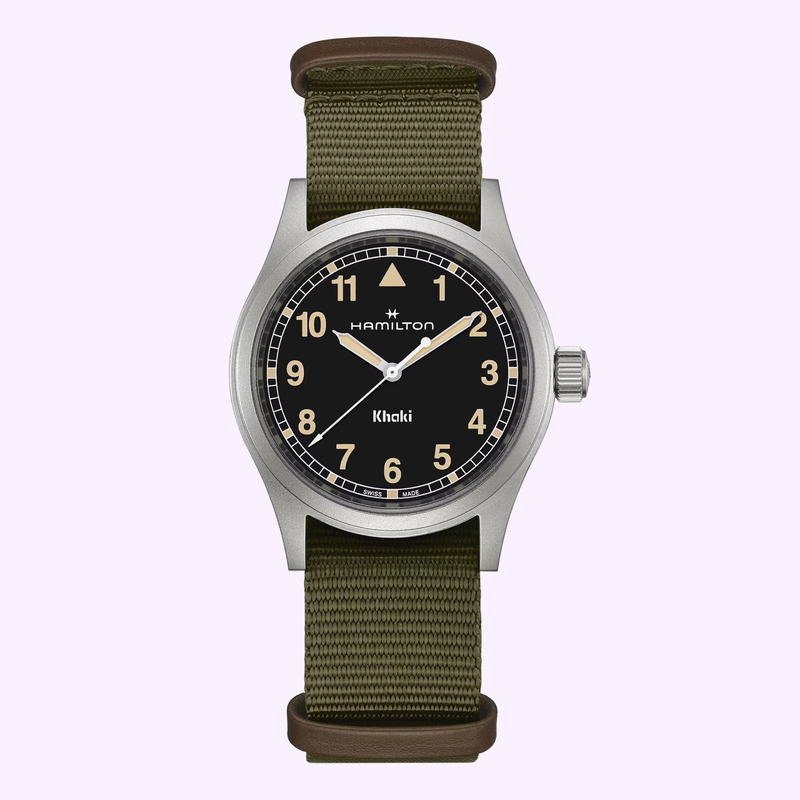

Hamilton Khaki Field Quartz, available in two dial colorways — a real-world example of a caliber F06.105 quartz movement.
What Is a Mechanical (Hand-Wound) Watch?
A mechanical watch is powered entirely by a mainspring that you wind by hand. As the spring unwinds, it releases energy through a gear train and an escapement, which regulates the release of that energy to move the hands at a steady rate. There is no battery and no self-winding rotor — the watch only runs as long as you keep winding it.
How it works: Hand-winding the crown → mainspring stores energy → gear train → escapement regulates release → hands move.
Pros:
- The purest expression of traditional watchmaking — an entirely mechanical object with no electronics
- Smooth, sweeping second hand
- Deep engagement with the watch: winding it daily becomes part of the ritual of wearing it
- Often more affordable than automatics with comparable finishing, since there's no rotor mechanism to engineer
- Highly collectible and often visible through an exhibition case back
- Thinner case profiles than automatics, since there's no rotor taking up vertical space
Cons:
- Requires daily winding (most hold a 40–80 hour power reserve)
- Less accurate than quartz — typically within a few seconds to a minute per day, depending on the caliber
- Needs servicing roughly every 3–5 years
- Will stop if not worn or wound regularly
Notable hand-wound calibers: Hamilton's H-50 caliber, found in field watches like the Khaki Field Mechanical, is a modern hand-wound movement with an 80-hour power reserve — unusually long for a hand-wound caliber, since most hover around 40–46 hours. This kind of engineering shows how brands are modernizing traditional hand-wound movements to fit contemporary lifestyles without adding a rotor.
Best for: collectors and enthusiasts, buyers who want a hands-on relationship with their watch, dress watches worn a few days a week.
Shop Mechanical & Hand-Wound Watches →
[IMAGE PENDING: Hamilton Khaki Field Mechanical H69399930 — link not yet confirmed on the live site; send the correct product URL and I'll swap this in]
What Is an Automatic (Self-Winding) Watch?
An automatic watch is a mechanical watch with an added rotor — a weighted piece that spins with the natural motion of your wrist and winds the mainspring automatically. You still get the entirely mechanical movement (no battery), but without the daily winding requirement of a hand-wound piece, as long as you wear it regularly.
How it works: Wrist motion → rotor spins → winds mainspring automatically → gear train → escapement → hands move.
Pros:
- No battery, no daily winding required with regular wear
- Smooth sweeping second hand
- Combines mechanical craftsmanship with everyday practicality
- Many modern automatics (like Powermatic 80 or Caliber 80 movements) hold an 80-hour power reserve, so they survive a weekend off the wrist
- Visible rotor and finishing through an exhibition case back on many models
Cons:
- Less accurate than quartz — typically within a few seconds to a minute per day
- Generally the most expensive of the three movement types, due to the added rotor mechanism
- Needs regular wear or a watch winder to stay running
- Requires servicing roughly every 3–5 years
- Slightly thicker cases than hand-wound equivalents, to accommodate the rotor
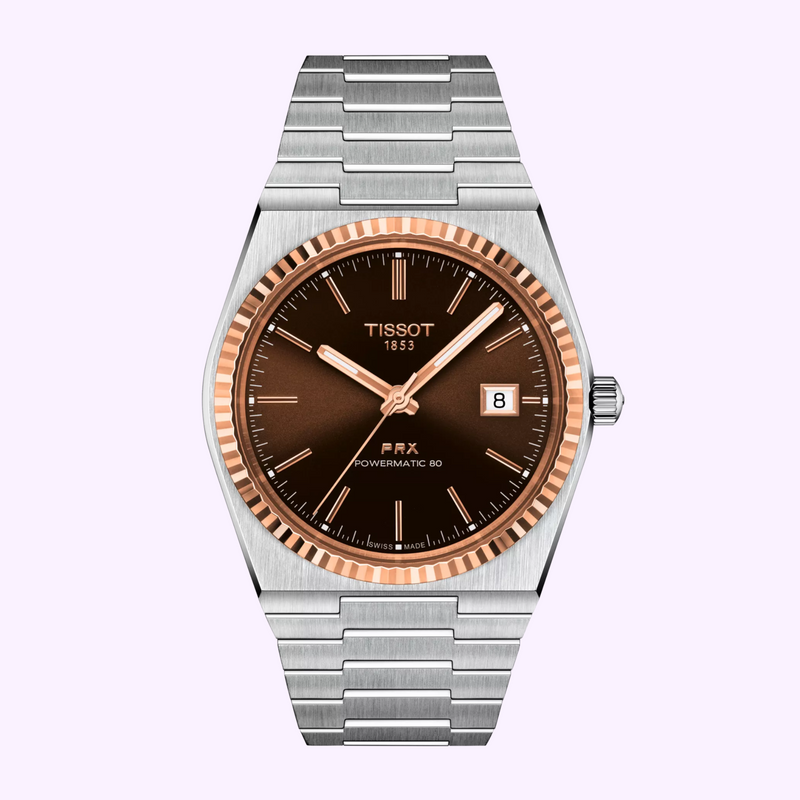
Notable automatic calibers: The Powermatic 80 family, used across Tissot and Mido, extended the traditional 38–42 hour power reserve of most automatics to a full 80 hours by slowing the escapement's oscillation rate — a meaningful engineering shift that means the watch can sit in a drawer over a long weekend and still be running (though not keeping perfect time) when you pick it back up. COSC-certified automatic movements, like those used in Frederique Constant's Highlife Automatic COSC, go through independent third-party testing in Switzerland to certify chronometer-level accuracy, typically -4/+6 seconds per day.
Best for: buyers who want a "real" mechanical watch without daily winding, everyday luxury wear, anyone building a long-term collection.

The Tissot PRX Powermatic 80's exhibition case back — you can see the rotor and finishing on the automatic movement.
Inside the Escapement: Why Mechanical Watches Aren't Perfectly Accurate
Every mechanical and automatic watch relies on an escapement — a small mechanism that releases the mainspring's stored energy in tiny, controlled increments, "ticking" the gear train forward at a steady rate. The most common type, the Swiss lever escapement, has been the industry standard for over a century.
The reason mechanical watches drift a few seconds a day (while quartz watches barely drift at all) comes down to physics: the escapement's balance wheel oscillates using a tiny hairspring, and that spring's rate is affected by temperature, position (whether the watch is face-up, face-down, or on its side), and how recently it was would. Watchmakers regulate movements to minimize this drift, and higher-grade movements (chronometer-certified, COSC-tested, or in-house calibers with free-sprung balances) achieve tighter tolerances than basic factory movements. But no mechanical escapement can match the vibrational consistency of a quartz crystal — which is precisely why quartz watches were considered a technological leap forward in 1969, even though mechanical watchmaking has remained more prestigious ever since.
[IMAGE PENDING: escapement mechanism close-up — could reuse the Tissot PRX case-back shot above if a separate technical diagram isn't available]
Cost of Ownership Over Time: Quartz vs Mechanical vs Automatic
Purchase price is only part of the story — each movement type carries a different long-term cost:
Quartz, over 10 years: Expect 3–5 battery replacements at roughly $10–$25 each (more for watches with special water-resistance gaskets that need replacing with the battery). Total maintenance cost: roughly $50–$125 over a decade, plus occasional gasket replacement to preserve water resistance.
Mechanical or automatic, over 10 years: Expect one full movement service around the 4–6 year mark, typically running $150–$400 depending on the brand and complexity, plus a possible second service if you're at the 8–10 year point. Total maintenance cost: roughly $150–$600+ over a decade — but a well-serviced mechanical or automatic watch can run accurately for generations, while a quartz watch's plastic circuit components eventually become harder to source for very old models.
The long-term trade-off: quartz costs less to maintain but has a shorter realistic service life for very old pieces; mechanical and automatic watches cost more to maintain but are built to be serviced indefinitely, which is a major reason they hold value better as heirloom pieces.
Common Myths About Watch Movements
"Automatic watches never need winding." Not quite — if an automatic sits unworn for more than a day or two (depending on its power reserve), it will stop, and most models need a manual wind of the crown before you strap it back on to get it started again.
"Mechanical watches are always more accurate than quartz." The opposite is true. Quartz is inherently more accurate; mechanical and automatic watches are valued for craftsmanship and tradition, not raw precision.
"Quartz watches are always cheap." Some of the most technically sophisticated quartz movements — like high-frequency and thermocompensated calibers — cost as much or more to engineer as mid-range mechanical movements, even though quartz as a category skews more affordable overall.
"A more expensive automatic is always more accurate." Price often reflects finishing, brand heritage, and complications more than raw timekeeping accuracy. A COSC-certified movement at a mid-range price point can outperform a much pricier automatic that isn't chronometer-rated.
"You can't wear a mechanical watch in the water." Water resistance depends on the case and gasket construction, not the movement type — many mechanical and automatic dive watches are rated to 200m or more, same as quartz dive watches.
How to Care for Each Movement Type
Quartz:
- Replace the battery promptly once it dies — a dead battery left inside can leak and damage the movement
- Have the case reseal-tested after every battery change if the watch is water-resistant
- No winding or special storage needed
Mechanical (hand-wound):
- Wind at the same time each day for consistency, ideally 20–30 half-turns of the crown until you feel resistance
- Never force the crown past resistance — this can damage the mainspring
- Store on its side or with the crown facing up when not worn, to reduce strain on specific balance positions
- Have it serviced every 3–5 years even if it seems to be running fine
Automatic:
- Wear it for at least 6–8 hours a day to keep it fully wound through normal wrist motion
- If you have a rotation of watches, consider a watch winder for automatics you wear infrequently
- If it stops, manually wind the crown 20–30 turns to restart the mainspring before resetting the time
- Have it serviced every 3–5 years, same as a hand-wound mechanical
How to Tell Which Movement Type a Watch Has Before You Buy
If you're shopping and the product page doesn't spell it out clearly, a few quick checks will tell you what's inside:
- Look at the second hand. A smooth, continuous sweep almost always means mechanical or automatic. A visible tick, once per second, means quartz.
- Check the case back. Many mechanical and automatic watches have a transparent exhibition case back so you can see the movement (and, on automatics, the spinning rotor). A solid metal case back doesn't rule out mechanical, but it's more common on quartz and entry-level automatics.
- Look for a "no-date quickset" or day/date correction behavior. Quartz watches almost always let you set the date instantly by pulling the crown; on many mechanical and automatic watches, date correction is restricted near midnight to avoid damaging the date-change mechanism.
- Feel the weight. This isn't a rule, but automatic movements (with their added rotor) are often slightly heavier than quartz movements in a similarly sized case, all else being equal.
- Read the caliber name. Listings that reference a specific caliber — Powermatic 80, Caliber 80, H-10, H-50, Precisionist, UHF — are telling you exactly what's inside; product pages on Lexor Miami list the caliber for this reason.
Watch Movements by Price Tier
Under $500: This range is dominated by quartz watches, along with a growing number of accessible automatics from brands leaning on simpler, mass-produced calibers. Expect solid daily-wear quality without in-house movement engineering.
$500–$1,500: This is where automatic watches become the dominant option, especially from established Swiss and Japanese brands using workhorse calibers like Powermatic 80, Caliber 80, or Seiko's 4R/6R series. Hand-wound mechanical watches in this range often come from heritage-focused field watch and dress watch lines.
$1,500–$5,000: Expect more refined finishing, in-house or heavily modified movements, COSC certification becoming more common, and additional complications (moonphase, chronograph, worldtimer) layered onto the automatic or mechanical base.
$5,000+: In-house manufacture movements, exhibition case backs with decorated finishing (Geneva stripes, perlage, blued screws), and limited editions become the norm — quartz is rare at this tier except in specialized high-accuracy or ultra-thin technical pieces.
Sustainability Considerations
Movement type also affects environmental footprint in a way many buyers don't consider. Quartz watches require periodic battery replacement — most standard watch batteries contain small amounts of mercury-free silver oxide today, but they still need proper disposal through a jeweler or battery recycling program rather than the trash. Mechanical and automatic watches, by contrast, generate no battery waste at all and are designed from the outset to be serviced and kept running for decades, sometimes generations, rather than replaced — which is part of why many collectors view them as the more sustainable long-term choice, despite the higher upfront cost and periodic servicing.
Glossary of Key Movement Terms
- Caliber: The specific model or engineering design of a watch movement (e.g., Powermatic 80, H-50).
- Mainspring: The coiled spring that stores energy in a mechanical or automatic watch.
- Escapement: The mechanism that releases the mainspring's energy in controlled increments, regulating timekeeping.
- Rotor: The weighted, spinning component in an automatic watch that winds the mainspring using wrist motion.
- Power reserve: How long a fully wound mechanical or automatic watch will keep running without additional winding.
- COSC: The official Swiss chronometer testing body that certifies movement accuracy.
- Quickset: A feature allowing the date to be corrected instantly via the crown, without moving through the full 24-hour cycle.
- Exhibition case back: A transparent case back that shows the movement, common on mechanical and automatic watches.
Comparison Table
| Quartz | Mechanical (Hand-Wound) | Automatic (Self-Winding) | |
|---|---|---|---|
| Power source | Battery | Mainspring, wound by hand | Mainspring, wound by wrist motion |
| Accuracy | Within 15 sec/month | Within seconds to ~1 min/day | Within seconds to ~1 min/day |
| Daily maintenance | None | Daily winding | None with regular wear |
| Second-hand movement | Ticking | Smooth sweep | Smooth sweep |
| Typical price range | Most affordable | Mid-range | Mid to high |
| Servicing | Battery swap every 1–3 yrs | Full service every 3–5 yrs | Full service every 3–5 yrs |
| 10-year maintenance cost | ~$50–$125 | ~$150–$400+ | ~$150–$400+ |
| Case thickness | Thinnest | Thin | Slightly thicker (rotor) |
| Best for | Daily reliability, first watch | Traditionalists, dress watches | Everyday luxury, collectors |
Browse the Full Watch Collection →
Which Movement Type Is Right for You?
Choose quartz if: you want a dependable daily watch with zero maintenance thinking, you're buying your first "real" watch, or precision matters more to you than heritage.
Choose mechanical (hand-wound) if: you appreciate the ritual of winding your watch, you want the most traditional expression of watchmaking, or you're drawn to dress watches with thin, elegant cases that a rotor would bulk up.
Choose automatic if: you want a mechanical watch that keeps running with normal daily wear, you're building a rotation of watches you don't wear every single day, or you want the best balance between heritage and convenience.
By lifestyle:
- The daily commuter who wants one dependable watch: Quartz — set it and forget it.
- The weekend collector building a small rotation: Automatic — modern 80-hour power reserves mean your watch is often still running Monday morning even after a watch-free weekend.
- The traditionalist who wants a slim dress watch: Mechanical (hand-wound) — thinner case, purest mechanical experience.
- The frequent traveler: Quartz or a high-power-reserve automatic — both handle time away from the wrist better than a standard hand-wound piece.
- The gift buyer choosing for someone else: Quartz is the safest choice if you're unsure whether the recipient will wear it daily; automatic is a stronger choice if you know they'll wear it regularly and want something with more prestige.
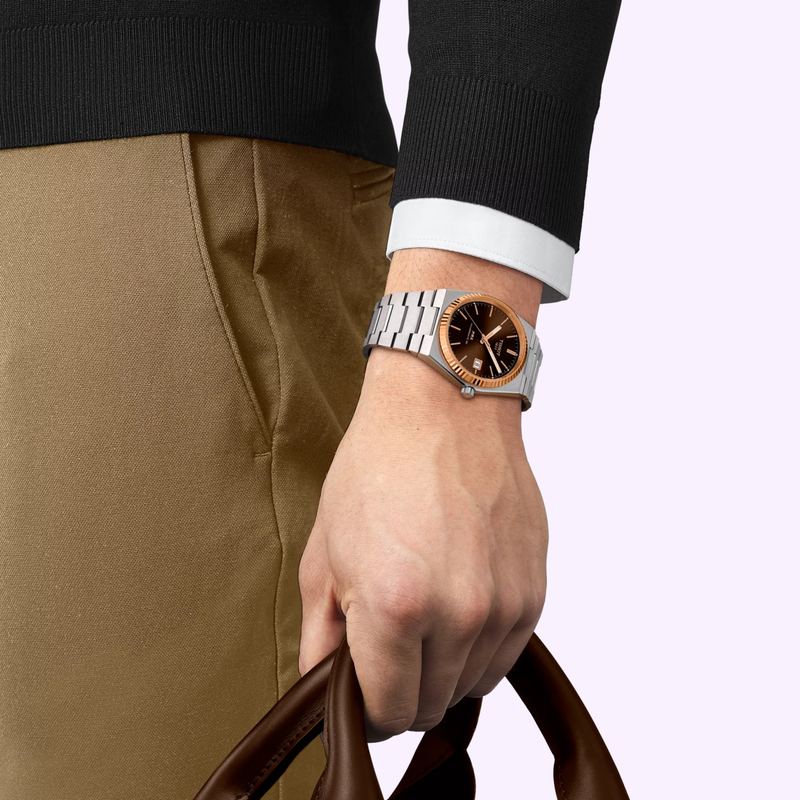
Real Examples from Lexor Miami's Collection
- Quartz: Hamilton Khaki Field Quartz 38mm (H69401960) — reliable field-watch accuracy in a compact, affordable case.
- Mechanical (hand-wound): Hamilton Khaki Field Mechanical 36mm (H69399930), a 2026 special edition inspired by historic field watches, powered by the hand-wound H-50 caliber with an 80-hour power reserve.
- Automatic: Tissot PRX Powermatic 80 (T1374071105100 / T1374071104102) — an 80-hour power reserve automatic in one of the most popular price-accessible Swiss automatics on the market.
- Automatic (luxury): Seiko Presage Cocktail Time "Eggnog" (SRE018) — a dressier automatic with an in-house Seiko movement.
- High-accuracy quartz: Bulova Lunar Pilot — built on Bulova's high-precision quartz heritage.
- COSC-certified automatic: Frederique Constant Highlife Automatic COSC (FC-303S3NH26B) — independently certified chronometer accuracy in a self-winding movement.
Browse the full collection to compare movement types side by side across Hamilton, Tissot, Seiko, Bulova, Mido, and Frederique Constant.

Seiko Presage Cocktail Time SRE018 — powered by the in-house Caliber 2R05 automatic movement, 40-hour power reserve.
Shop All Watches at Lexor Miami →
Frequently Asked Questions
1. Which movement type is the most accurate? Quartz, by a wide margin — typically accurate within 15 seconds per month, versus a few seconds to a minute per day for mechanical and automatic movements.
2. Do automatic watches need a battery? No. Automatic watches are powered entirely by a mainspring wound by the motion of your wrist — there's no battery or electronics involved.
3. How often do I need to wind an automatic watch? If you wear it daily, you typically never need to wind it by hand — wrist motion keeps it running. If it sits unworn, most automatics stop within 24–80 hours depending on their power reserve.
4. What happens if I stop wearing my automatic watch? It will eventually stop once the power reserve runs out. You'll need to manually wind it a few turns and reset the time and date before wearing it again, or store it on a watch winder.
5. Is a mechanical watch better than an automatic one? Neither is objectively "better" — mechanical (hand-wound) watches are typically thinner and more traditional, while automatics add everyday convenience. It comes down to whether you want the winding ritual or not.
6. How long does a quartz watch battery last? Most quartz watch batteries last 1–3 years depending on the movement and features (chronograph functions drain batteries faster).
7. Why are automatic watches more expensive than quartz watches? Automatic movements require more components (a rotor, additional gear train elements) and more hand-finishing and assembly than quartz movements, which drives up both material and labor cost.
8. Do mechanical and automatic watches need servicing? Yes — most manufacturers recommend a full movement service every 3–5 years to keep the watch accurate and prevent long-term wear damage.
9. Can a quartz watch be a luxury watch? Yes. Many respected Swiss and Japanese brands produce high-end quartz movements, including chronometer-certified quartz calibers. Quartz doesn't mean "cheap" — it means a different engineering approach.
10. What is a power reserve? Power reserve is how long a mechanical or automatic watch will keep running once fully wound, without additional winding or wrist motion. Many modern automatics offer 80-hour power reserves, enough to sit unworn over a weekend.
11. Which movement type holds its value best? Mechanical and automatic watches, particularly from established Swiss and Japanese manufacturers, tend to hold value and collectibility better than quartz models, which are generally valued for utility rather than as collector pieces.
12. Should my first "real" watch be automatic or quartz? Either works well as a first serious watch. Quartz is the lower-maintenance, lower-cost entry point; an automatic is a great choice if you want to start learning the ritual of mechanical watch ownership from day one.
13. What does COSC certification mean? COSC (Contrôle Officiel Suisse des Chronomètres) is an independent Swiss testing body that certifies mechanical and automatic movements meet strict accuracy standards, typically -4/+6 seconds per day, after 15 days of testing in multiple positions and temperatures.
14. Why does my mechanical watch run differently depending on how I store it? Gravity affects the balance wheel and hairspring differently depending on the watch's position (face-up, face-down, crown-up, etc.), which is why watchmakers regulate movements across multiple positions and why some enthusiasts store watches in a specific position overnight to average out timekeeping.
15. Can I switch between wearing a quartz and an automatic watch regularly? Yes — there's no downside to rotating between movement types. Just remember an automatic will need a quick reset if it's been off your wrist for more than a day or two.
16. Is it normal for an automatic watch to run a little fast or slow? Yes. A variance of a few seconds to under a minute per day is considered normal and within spec for most automatic movements — it's not a defect unless the drift is significantly larger or inconsistent.
Final Thoughts
There's no universally "correct" movement type — only the right one for how you actually live with a watch. If you want to put a watch on in the morning and never think about it again, quartz will serve you well for years at minimal cost. If you're drawn to the idea of a small mechanical object that you wind by hand each morning as part of your routine, a hand-wound mechanical watch offers that ritual in its purest form. And if you want the heritage and craftsmanship of a mechanical movement without having to think about winding at all, an automatic gives you the best of both worlds, as long as you wear it regularly or keep it on a winder.
Many serious collectors end up owning all three — a quartz watch for travel and rough daily wear, an automatic for regular rotation, and a hand-wound mechanical for dress occasions. There's no wrong way to build a collection; understanding what's actually happening inside each movement just makes it easier to choose with confidence, and to know what you're getting for your money at every price point.
At Lexor Miami, every watch listing specifies its movement type and caliber up front, so you can compare quartz, mechanical, and automatic options side by side across Hamilton, Tissot, Seiko, Bulova, Mido, and Frederique Constant before you decide.
Shop the Full Watch Collection →


