
Mido Ocean Star 200 vs Seiko Prospex vs Tissot Seastar vs Longines HydroConquest: Which One Should You Buy in 2026?
If you have spent any real time comparing automatic dive watches under $2,500, you already know the shortlist. The Mido Ocean Star 200, the Seiko Prospex collection, the Tissot Seastar 1000 Powermatic 80, and the Longines HydroConquest show up again and again in the same forum threads, the same Reddit "which one should I buy" posts, and the same spreadsheets watch buyers build before pulling the trigger. All four are legitimate Swiss or Japanese automatic divers. All four are backed by serious manufacturing groups. And all four solve the same problem in slightly different ways.
This guide breaks down exactly how the Mido Ocean Star 200 Automatic 200m stacks up against its three closest rivals — movement for movement, spec for spec, dollar for dollar — so you can make a decision with real data instead of marketing copy. We will also explain why, for most buyers in the United States, the Ocean Star 200 ends up being the smartest place to put your money in 2026.
Shop the Mido Ocean Star 200 at Lexor Miami
Why These Four Watches Keep Getting Compared
The Mido Ocean Star 200, Seiko Prospex, Tissot Seastar 1000 Powermatic 80, and Longines HydroConquest all occupy the same shopping search: "automatic dive watch, 200m or more water resistance, sapphire crystal, under $2,500, from a brand with real watchmaking history." That is a narrow and competitive space, and each brand approaches it with a different philosophy.
Mido and Tissot are both part of the Swatch Group's mid-tier lineup and share components with the ETA/Powermatic ecosystem. Longines sits one tier above them inside the same Swatch Group family, with its own in-house-adjacent L888 caliber and a noticeably higher price point. Seiko is the outlier — a fully independent Japanese manufacture that builds its own 6R-series movements from the ground up, with a design language rooted in the brand's own diving heritage rather than Swiss dive-watch conventions.
Understanding those differences in ownership, movement architecture, and pricing strategy is the fastest way to figure out which watch actually deserves your money — not just which one has the most attractive product photography.
Brand Heritage: A Quick Reality Check
Mido was founded in Biel, Switzerland in 1918 and has been part of the Swatch Group for decades. The Mido Ocean Star collection traces its roots to 1944, when Mido was among the earliest brands experimenting with water-resistant case construction. Mido does not spend heavily on celebrity endorsements or Hollywood product placement the way some of its Swatch Group siblings do — its reputation has been built almost entirely on watch-community word of mouth, which is exactly why it still surprises first-time buyers with how much watch you get for the price.
Seiko needs less introduction in the diving world. Seiko released Japan's first purpose-built diver's watch in 1965 and has been refining that formula for six decades through the Prospex line. Seiko's advantage is vertical integration — it designs and manufactures its own movements, cases, and even some of its own steel alloys, rather than sourcing components from a shared supplier group.
Tissot, also founded in 1853 and based in Le Locle, is the volume leader inside the Swatch Group's affordable-luxury tier. The Seastar collection is Tissot's dedicated dive-watch line, and it leans on the same Powermatic 80 movement family that powers many of Swatch Group's higher-volume automatics.
Longines, founded in 1832 and also headquartered in Saint-Imier, sits directly above Mido and Tissot in the Swatch Group hierarchy. The HydroConquest line uses Longines' own L888 caliber (based on an ETA A31.L01 architecture) and is positioned as a step up in finishing, movement decoration, and case detailing — which shows up clearly in the price.
Movement & Power Reserve: Where the Real Differences Show Up
This is the category that actually separates these four watches on paper, and it is worth reading closely before you look at price.
The Mido Ocean Star 200 runs on Mido's Caliber 80, an automatic movement built on the ETA C07.621 architecture — the same broader Powermatic 80 family used across Swatch Group. It delivers up to 80 hours of power reserve and includes a Nivachron™ balance spring, which improves resistance to magnetic fields and everyday shocks compared to a standard alloy spring. That combination — extended autonomy plus meaningfully better shock and magnetism resistance — is not something you find on every watch in this price bracket.
The Tissot Seastar 1000 Powermatic 80 uses the closely related ETA C07.111 caliber, also rated at 80 hours of power reserve. Functionally, the movement architecture is a close cousin of Mido's — both trace back to the same Powermatic 80 platform — though Tissot's execution does not include the Nivachron spring on every reference.
The Longines HydroConquest uses the in-house-branded Caliber L888, running at a higher 25,200 vibrations per hour with roughly 72 hours of power reserve. It is a well-regarded movement with clean finishing, but it trades a small amount of power reserve compared to the Mido and Tissot Powermatic 80 movements.
The Seiko Prospex line (in the comparable 41mm automatic diver references) runs Seiko's own Caliber 6R35, offering approximately 70 hours of power reserve at a more traditional 3Hz beat rate. It is a proven, field-tested movement, but it sits at the bottom of this group in raw power reserve, and it does not include a specialized anti-magnetic balance spring.
On pure movement specification, the Ocean Star 200's Caliber 80 comes out on top of this group — tied for the longest power reserve and the only one of the four with a dedicated anti-magnetic balance spring as standard.
Case Size, Comfort & Everyday Wearability
All four watches land in a similar wrist footprint, but the details matter if you plan to wear the watch daily rather than just admire it in a drawer.
The Mido Ocean Star 200 M0269301101100 measures 41mm in diameter and just 11.7mm thick, built in 316L stainless steel with a mix of satin and polished surfaces. The Seiko Prospex divers in this comparison class run close, typically 41mm with a slightly thicker 12–13mm profile depending on the reference. The Tissot Seastar 1000 is a bit larger at 43mm, and the Longines HydroConquest is available at both 41mm and 43mm depending on the reference, with the 41mm version being the more direct match for this comparison.
Lug width is another practical detail buyers search for constantly. The Ocean Star 200 uses a 21mm lug width, matching the Tissot Seastar and Longines HydroConquest almost exactly, which means strap and bracelet compatibility across this category is more forgiving than buyers often expect.
If wrist comfort for daily wear is your top priority, the Mido and the comparable Seiko references sit in the sweet spot — substantial enough to read as a serious dive watch, compact enough not to dominate a smaller wrist.
Water Resistance & Dive-Ready Features
Every watch on this list is built for real water exposure, not just splash resistance, but the numbers differ in a way that matters if you actually dive.
- Mido Ocean Star 200: 200m / 660ft, unidirectional rotating bezel, screw-down crown, sapphire crystal with double-sided anti-reflective coating
- Seiko Prospex (comparable references): 200m, unidirectional rotating bezel, screw-down crown, sapphire crystal
- Tissot Seastar 1000 Powermatic 80: 300m / 1000ft, unidirectional rotating bezel, screw-down crown and case back, sapphire crystal
- Longines HydroConquest: 300m / 30 bar, ceramic unidirectional bezel, screw-down crown, sapphire crystal with multi-layer anti-reflective coating
Here is where buyers need to separate marketing numbers from real-world use. Unless you are doing saturation or technical diving — which almost none of the people comparison-shopping these four watches actually are — the jump from 200m to 300m makes no practical difference for swimming, snorkeling, or recreational scuba diving. All four watches exceed what any recreational diver will ever need. The Mido Ocean Star 200 also equips a diver extension, folding clasp with safety lock, and double push-buttons on its bracelet — hardware you would expect on a watch rated well past its own number.
Price & Value: The Category That Actually Decides Most Purchases
This is where the comparison becomes genuinely one-sided.
| Watch | Movement | Power Reserve | Water Resistance | Case Size | Typical Price (USD) |
|---|---|---|---|---|---|
| Mido Ocean Star 200 | Caliber 80 (Nivachron) | Up to 80 hours | 200m | 41mm | $980 |
| Seiko Prospex (comparable ref.) | Caliber 6R35 | Approx. 70 hours | 200m | ~41mm | ~$1,050–$1,100 |
| Tissot Seastar 1000 Powermatic 80 | ETA C07.111 | Up to 80 hours | 300m | 43mm | ~$875–$925 |
| Longines HydroConquest (41mm, steel) | Caliber L888 | Approx. 72 hours | 300m | 41mm | ~$2,150+ |
Pricing reflects typical U.S. retail for comparable references as of 2026 and will vary by dial color, bracelet material, and specific reference number.
Look closely at where the Ocean Star 200 lands. At $980, it undercuts the comparable Seiko Prospex reference by roughly $100–150, while offering a longer power reserve and a dedicated anti-magnetic balance spring the Seiko does not have. It sits close to the Tissot Seastar 1000 on price while adding the Nivachron spring the Tissot lacks. And against the Longines HydroConquest, the Mido delivers a functionally similar spec sheet — same lug width, similar case size, comparable finishing quality — for less than half the price.
That gap is the entire reason the "hidden gem" reputation around Mido keeps showing up in watch forums and Reddit threads. The brand is not chasing marketing spend the way its Swatch Group siblings are, so the value gets built into the watch instead of the ad budget.
Which One Should You Actually Buy?
There is no universally "best" watch in this group — there is a best watch for your priorities. Here is how the decision typically breaks down:
Choose the Mido Ocean Star 200 if you want the strongest overall value: the longest power reserve tied with Tissot, the only anti-magnetic Nivachron spring in the group, a wearable 41mm case, and genuine Swiss manufacturing — all for well under $1,000.
Choose the Seiko Prospex if in-house Japanese manufacturing and Seiko's specific diving heritage matter more to you than price, and you are comfortable paying more for a shorter power reserve.
Choose the Tissot Seastar 1000 if you specifically want 300m of rated water resistance and a slightly larger 43mm case, and don't need the anti-magnetic spring.
Choose the Longines HydroConquest if budget is not the deciding factor and you want the extra tier of in-house movement finishing and brand prestige that comes with stepping up inside the Swatch Group hierarchy.
For the majority of buyers comparison-shopping this exact list — people who want a genuinely capable Swiss automatic diver without overpaying — the math points squarely at the Mido Ocean Star collection.
Featured Watch

Mido Ocean Star 200 Automatic 200m
$980.00
Reference M026.930.11.011.00. A 41mm 316L stainless steel Swiss automatic dive watch powered by Mido's Caliber 80, delivering up to 80 hours of power reserve and a Nivachron™ balance spring for enhanced shock and magnetic resistance. 200m water resistance, sapphire crystal with double-sided anti-reflective coating, and a stainless steel bracelet with diver extension. Backed by a 2-year manufacturer's warranty.
Shop NowMore Angles on the Mido Ocean Star 200
Photos only tell part of the story with this watch. The dial texture, the way the satin and polished surfaces of the case catch light, and the proportions of the bracelet are easier to appreciate up close.
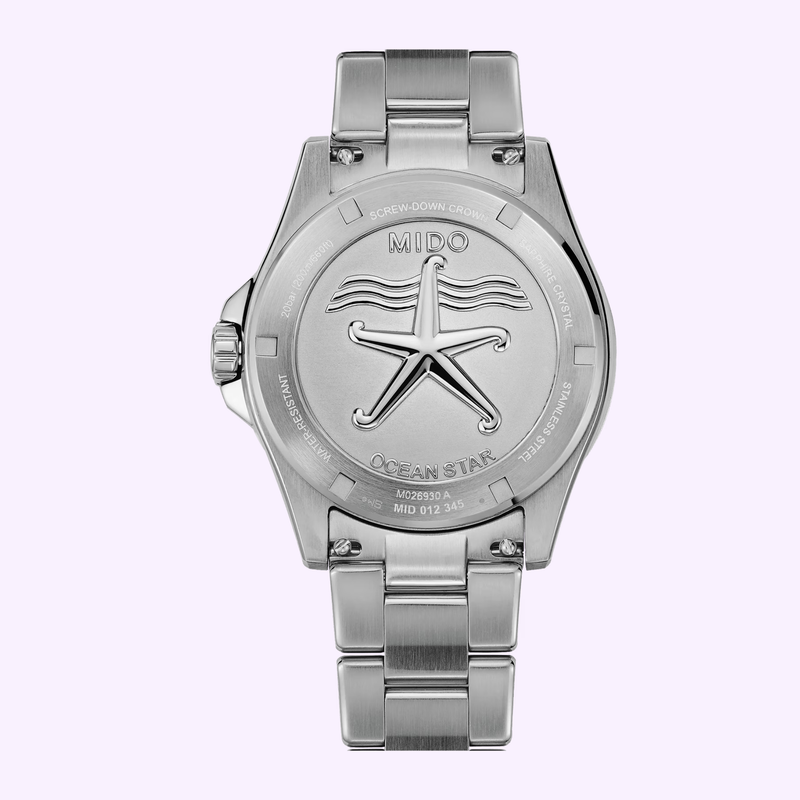
The screw-down case back is engraved with Mido's Ocean Star emblem, a detail carried across the collection since its earliest dive watches. It is a small touch, but it is the kind of finishing detail that separates a watch built by a real manufacture from a watch assembled to hit a price point.
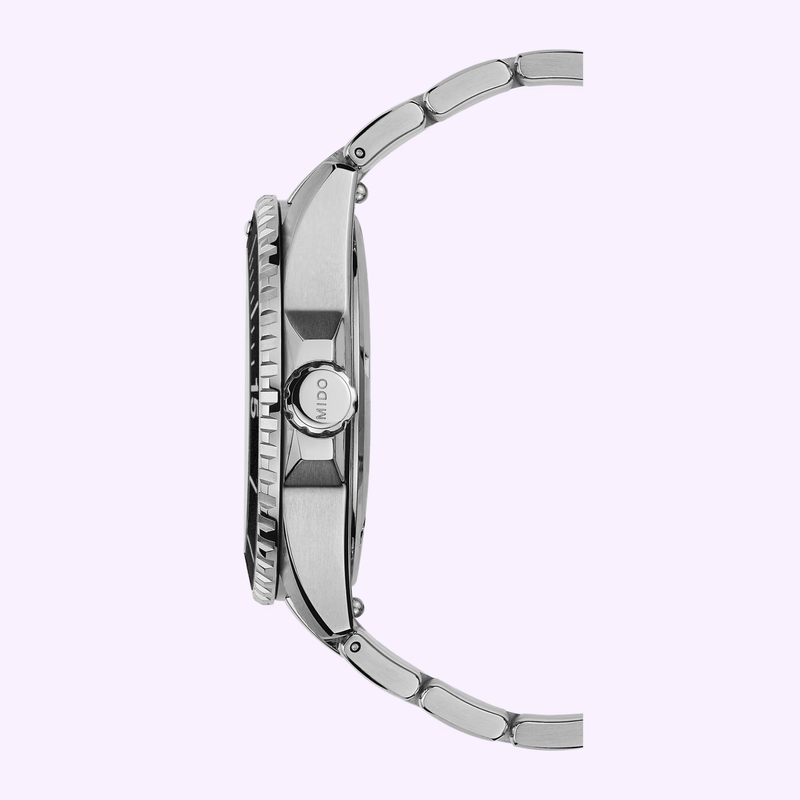
At 11.7mm thick, the case profile stays low enough to slide under a shirt cuff comfortably — something buyers coming from bulkier 13mm+ dive watches consistently notice within the first week of wear.
View Full Specs & Buy at Lexor Miami
Buying From an Authorized Dealer Matters More Than People Realize
One question that comes up constantly in comparison research like this is authenticity. Chrono24, Jomashop, and various gray-market resellers list all four of these watches, often at prices that look tempting — but gray-market purchases frequently come with reduced or voided manufacturer warranties, unclear service history, and no accountability if something arrives with a defect.
Lexor Miami is a Mido authorized dealer, listed directly on Mido's official store locator. Every Ocean Star 200 sold through the Mido Watches collection at Lexor Miami ships brand new, with full manufacturer packaging and a genuine 2-year international warranty — not a third-party seller's warranty. That distinction is exactly what separates a confident purchase from a gamble, and it is one of the biggest practical advantages Lexor Miami holds over marketplace resellers in this comparison.
Shop the Authorized Mido Ocean Star 200
Final Thoughts
All four of these watches are legitimate, well-built automatic divers, and none of them will let you down mechanically. But when you line up power reserve, anti-magnetic protection, case wearability, and price side by side, the Mido Ocean Star 200 is the watch that wins the most categories relative to its cost. It is the rare case where the "value pick" in a comparison is not a compromise — it genuinely out-specs watches priced well above it.
Quick recap of where each watch stands:
- Mido Ocean Star 200 — $980 · Caliber 80, 80-hour reserve, Nivachron spring, 200m, 41mm — best overall value
- Seiko Prospex (comparable ref.) — ~$1,050–$1,100 · Caliber 6R35, 70-hour reserve, 200m, ~41mm — best for in-house Japanese heritage
- Tissot Seastar 1000 Powermatic 80 — ~$875–$925 · ETA C07.111, 80-hour reserve, 300m, 43mm — best for 300m rating on a budget
- Longines HydroConquest (41mm) — ~$2,150+ · Caliber L888, 72-hour reserve, 300m, 41mm — best for step-up prestige and finishing
If your goal is the strongest specification-to-price ratio in this entire group, the decision is straightforward.
Get the Mido Ocean Star 200 at Lexor Miami
Frequently Asked Questions
Is the Mido Ocean Star 200 a good watch for the price?
Yes. At $980, the Ocean Star 200 offers an 80-hour power reserve, a Nivachron anti-magnetic balance spring, a 316L stainless steel case, sapphire crystal, and 200m of water resistance — a spec sheet that typically appears on watches priced several hundred dollars higher. It is widely regarded in the watch community as one of the strongest value propositions in Swiss automatic diving watches.
How does the Mido Ocean Star 200 compare to the Seiko Prospex in terms of movement quality?
Both are reliable, well-tested automatic movements. The Mido's Caliber 80 offers a longer power reserve (up to 80 hours versus roughly 70 hours) and includes a Nivachron balance spring for added resistance to magnetic fields, which the comparable Seiko Prospex 6R35-powered references do not include. Seiko's advantage is that its movement is manufactured entirely in-house.
Is 200m water resistance enough for diving?
Yes. 200m of water resistance meets or exceeds ISO 6425 diving watch standards and is more than sufficient for recreational scuba diving, snorkeling, and swimming. The additional 100m offered by the Tissot Seastar and Longines HydroConquest (300m total) provides extra margin but makes no practical difference for recreational use.
What size wrist fits the Mido Ocean Star 200 best?
At 41mm in diameter, 11.7mm thick, and with a 21mm lug width, the Ocean Star 200 is proportioned for most average to larger wrists (roughly 6.5 inches and up) while remaining slim enough not to feel oversized. It is comparable in size to the 41mm Seiko Prospex and Longines HydroConquest references, and slightly more compact than the 43mm Tissot Seastar 1000.
Why is the Mido Ocean Star 200 cheaper than the Longines HydroConquest if they're both Swatch Group brands?
Mido and Longines occupy different tiers within the Swatch Group portfolio. Longines sits above Mido and Tissot in brand positioning, movement finishing, and marketing investment, which is reflected directly in retail pricing. The underlying performance gap — power reserve, water resistance, case quality — is much smaller than the price gap suggests.
Where can I buy an authentic Mido Ocean Star 200 in the U.S.?
Lexor Miami is an authorized Mido dealer, listed on Mido's official store locator. Every Ocean Star 200 purchased through the Mido Watches collection at Lexor Miami is 100% authentic, ships brand new with full packaging, and includes a genuine 2-year manufacturer's warranty, along with free U.S. shipping and free returns.
Continue Exploring Dive Watches at Lexor Miami
Want to see how the Ocean Star 200 fits into a broader collection story, or compare it against more Seiko and Hamilton dive references? Check out these related guides:
- Watches with a Story: Hamilton Murph, Bulova Shelby Racer & Mido Ocean Star — The Ultimate 2026 Buying Guide
- The Ultimate Alpinist, Diver & GMT Buying Guide
- Seiko Prospex SRPE99 PADI Special Edition Review
- Hamilton Khaki Navy Scuba Auto 40mm H82425110: Full Review & Buying Guide
Browse the full Mido Watches collection at Lexor Miami to see every Ocean Star reference currently in stock, all backed by authorized-dealer warranty and free U.S. shipping.


