
Hamilton Khaki Navy Scuba Buying Guide: Size, Dive Rating & Tissot/Seiko Comparison
If you've been circling the Hamilton Khaki Navy Scuba Auto for a few weeks now, you've probably run into the same three questions every American buyer eventually asks: should you get the 40mm or step up to the larger 42-43mm version, is this actually a real dive watch or just dive-watch styling, and how does it really compare to the Tissot and Seiko divers sitting in the same price range? This guide answers all three, in plain terms, using real specifications rather than marketing copy — so you can buy the right Hamilton the first time.
It's a fair set of questions to ask before spending close to a thousand dollars. Dive-style watches are one of the most crowded categories in modern watchmaking, and the marketing language brands use — "dive-inspired," "water sport ready," "built for adventure" — often blurs the line between a watch that merely looks the part and one that's actually engineered to a recognized diving standard. Add in a model lineup that spans two different case sizes, two different bezel materials, and two very different water-resistance ratings, and it's easy to see why so many buyers land on a forum or a comparison thread before ever clicking "add to cart." This guide walks through the full lineup, the real specifications behind the marketing, and how the Hamilton stacks up against its two most-compared rivals, so you can make a confident, informed decision.
What Is the Hamilton Khaki Navy Scuba Auto Collection?
Hamilton's Khaki Navy Scuba line is the brand's modern take on the classic dive-inspired sport watch — a category built around rotating bezels, screw-down crowns, and water resistance ratings, but designed just as much for everyday wear as for actual time underwater. The collection sits inside Hamilton's broader Khaki family, which also includes the Khaki Field (military-inspired) and Khaki Aviation (pilot-inspired) lines, all of which trace back to Hamilton's history supplying precision timepieces to the U.S. railroads and armed forces since 1892.
What makes the Khaki Navy Scuba distinct is its balance of price and specification. At $975 for the 40mm reference, it delivers a genuine Swiss automatic movement, an 80-hour power reserve, and a Nivachron anti-magnetic balance spring — features that are unusual to find together at this price point, regardless of brand. It's positioned squarely between mainstream automatic divers from Seiko and Citizen on one side, and higher-end Swiss divers from Omega and Tudor on the other, making it one of the most-searched "value Swiss diver" options among American buyers this year.
The line currently spans several case sizes and materials — a 40mm stainless steel version with a standard aluminum bezel, and a larger 43mm version with a ceramic bezel and significantly higher water resistance. Within the 40mm range, Hamilton also offers a dial and strap options, including the wave-textured white dial reference this guide focuses on: the H82425110.
A Brief History of Hamilton's Diving Heritage
Hamilton was founded in 1892 in Lancaster, Pennsylvania, and built its early reputation on railroad-grade precision — the brand's pocket watches were trusted to keep American trains running on schedule and prevent scheduling collisions, a job that demanded genuine, tested reliability rather than decorative accuracy. That same standard carried Hamilton through both World Wars, where the company became a key supplier of military watches, marine chronometers, and navigational instruments to U.S. forces, including timepieces genuinely relied upon by naval personnel operating in and around open water.
In 1969, Hamilton relocated its watchmaking operations to Bienne, Switzerland, eventually becoming part of the Swatch Group, and has operated as a Swiss Made manufacturer ever since while retaining its distinctly American design identity. The Khaki Navy collection is a direct continuation of that naval and diving heritage, translating the functional architecture of vintage dive instruments — rotating bezels, screw-down crowns, high-legibility dials — into a modern, comfortably wearable watch. Understanding that history helps explain why the Khaki Navy Scuba looks and feels the way it does: every design cue traces back to a genuine functional origin, not just current dive-watch trends.
40mm vs 42mm vs 43mm: Which Hamilton Khaki Navy Scuba Size Should You Buy?
This is, by a wide margin, the most common point of confusion for buyers researching this watch. Hamilton doesn't currently sell a 42mm Khaki Navy Scuba — that size existed in a previous generation of the line — but the confusion persists in online forums and old listings, so it's worth clarifying exactly what's available today: a 40mm stainless steel version and a larger 43mm ceramic-bezel version, with meaningfully different specs beyond just case diameter.
| Spec | 40mm (H82425110) | 43mm Ceramic Bezel |
|---|---|---|
| Case Diameter | 40mm | 43mm |
| Case Thickness | 13mm | ~14mm |
| Bezel Material | Aluminum insert | Ceramic insert |
| Water Resistance | 100m / 10 bar | 300m / 30 bar |
| Movement | H-10 Automatic | H-10 Automatic |
| Power Reserve | 80 hours | 80 hours |
| Approx. Price | $975 | $1,200+ |
The practical takeaway: if your wrist measures under about 7 inches, or you simply prefer watches that sit lower and lighter, the 40mm case is going to wear noticeably more comfortably — and it's the size most owners with average-to-smaller wrists report enjoying most in real-world use. The 43mm ceramic version is the better pick if you want maximum water resistance and a bolder, more ISO-diver-like presence on the wrist, and you don't mind the added weight and thickness that comes with it. For the majority of American buyers shopping for a daily-wear watch that transitions between the pool, the office, and dinner out, the 40mm H82425110 hits the more versatile mark — which is also reflected in it being the size most frequently recommended in owner discussions comparing the two generations.
One more sizing detail worth knowing: despite the 40mm case, the lug-to-lug length on this generation sits close to 47-50mm, and the lug width is 20mm — both important numbers if you're planning to wear it under a shirt cuff or swap onto an aftermarket strap.
Is the Hamilton Khaki Navy Scuba Actually a Dive Watch?
This is the second question worth answering honestly, because the name genuinely misleads some buyers. Despite "Scuba" appearing directly in the model name, the 40mm Khaki Navy Scuba is not ISO 6425 certified — the international standard that defines what qualifies as a true diver's watch, requiring things like a minimum 100m rating tested under specific conditions, anti-magnetic resistance, shock resistance, and a bezel that can be operated underwater with gloves. Hamilton itself does not market or recommend the 40mm version for actual scuba diving, positioning it instead as a dive-inspired sport watch.
That distinction matters, but it isn't necessarily a downside — it depends entirely on what you actually plan to do with the watch. With a genuine 100 meters of water resistance, a properly screwed-down crown, and a functioning unidirectional bezel, the H82425110 is more than capable of swimming, snorkeling, showering, and general water exposure. What it isn't built or certified for is technical scuba diving with a dive computer as backup, where ISO 6425 certification and typically 200m+ resistance are the accepted minimum standard serious divers look for.
If your actual use case is beach days, pool time, boat trips, and everyday water exposure, the 100m rating on the 40mm Khaki Navy Scuba is more than sufficient, and arguably the more sensible choice than an over-specified 300m diver you'll never take past a swimming pool. If you are a certified diver looking for a genuine dive instrument, either the 43mm ceramic Khaki Navy Scuba at 300m or a dedicated ISO-rated diver from Seiko's Prospex range is the more appropriate tool for the job.
It's also worth understanding what "100m water resistance" actually means in practical terms, since the number alone can be misleading in either direction. Water-resistance ratings are tested under laboratory conditions and don't account for the added pressure of movement, temperature changes, or an aging gasket — which is why watch manufacturers generally recommend treating a 100m rating as safe for swimming and snorkeling, but not for high-impact water sports like water skiing or repeated diving, where a wider safety margin matters more. In other words, the Hamilton's 100m rating is genuinely generous for how most owners will actually use it, even though it reads as modest next to a 300m ISO-certified instrument on a spec sheet.
Inside the Watch: H-10 Movement, Power Reserve & Nivachron
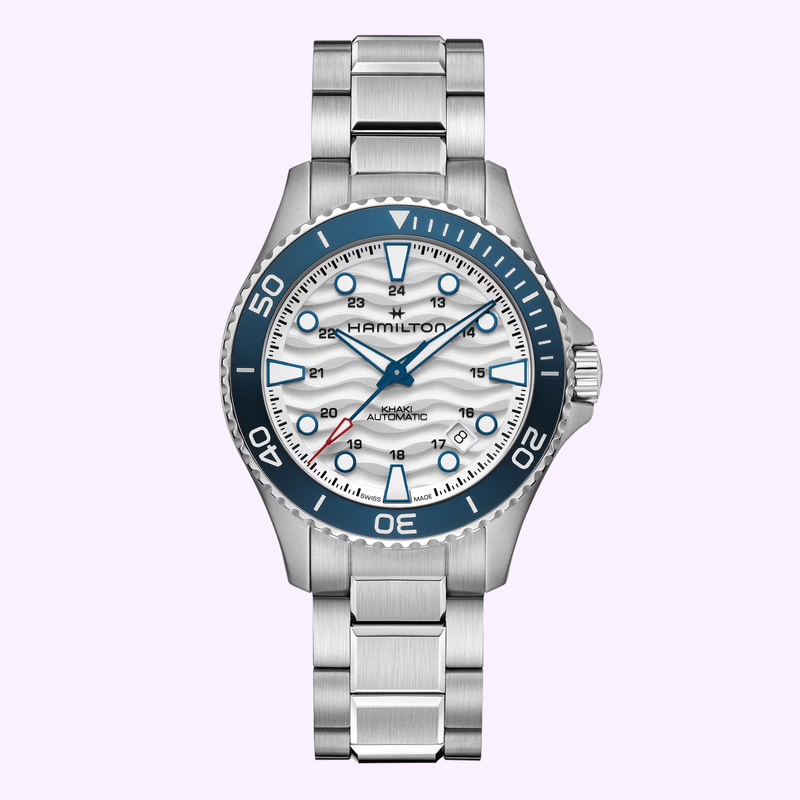
The lacquered white wave-textured dial of the Hamilton H82425110, viewable in full at Lexor Miami.
The single biggest technical selling point of every current Khaki Navy Scuba, regardless of size, is the H-10 caliber inside it. This automatic movement delivers an 80-hour power reserve — roughly double the 38-42 hours you'd get from a standard ETA 2824-based automatic, and matched in this price bracket only by watches using Swatch Group's own Powermatic 80 architecture, such as Tissot's Seastar and PRX lines. In practice, that means the watch can sit in a drawer over a long weekend and still be running, and reasonably accurate, when you pick it back up.
The second technical highlight is the Nivachron balance spring, a niobium-zirconium alloy that resists magnetism far more effectively than a traditional steel spring. Modern life is full of magnetic fields — phone speakers, laptop covers, wireless chargers, tablet cases — that can throw off a mechanical watch's accuracy without the owner ever realizing why. Nivachron largely neutralizes that risk, a genuinely useful piece of engineering that most competitors at this price point simply don't include.
Rounding out the technical package: a scratch-resistant sapphire crystal with anti-reflective coating, Super-LumiNova on the hands and markers for low-light legibility, and a screw-down crown that, combined with the case's 100m rating, makes this a watch you genuinely don't need to think twice about wearing in the water.
Hamilton Khaki Navy Scuba vs. Tissot Seastar 1000 Powermatic 80
Of all the comparisons buyers make before purchasing this watch, Hamilton vs. Tissot is the one that comes up most often — and for good reason, since both brands sit under the Swatch Group umbrella and both watches use Powermatic 80-family movements with 80-hour power reserves and Nivachron balance springs. The real differences come down to water resistance, case options, and overall character.
| Spec | Hamilton H82425110 (40mm) | Tissot Seastar 1000 Powermatic 80 (40mm) |
|---|---|---|
| Movement | Hamilton H-10 | Powermatic 80 (ETA C07.111) |
| Power Reserve | 80 hours | 80 hours |
| Water Resistance | 100m | 300m |
| Case Thickness | 13mm | ~12.6mm |
| Balance Spring | Nivachron | Nivachron |
| Approx. Price | $975 | $775-$895 |
On paper, the Tissot Seastar 1000 40mm is the more aggressively specified watch for the money — 300 meters of water resistance against the Hamilton's 100 meters, at a lower price. If raw water-resistance numbers are what matters most to you, Tissot wins this comparison outright. But most buyers researching this exact matchup aren't actually choosing based on depth rating; they're choosing based on design language, dial character, and brand feel, since neither watch is likely to see real diving use.
Where the Hamilton distinguishes itself is in that wave-textured, lacquered dial finish — a more dimensional, tactile design element than the Seastar's more conventional sunray dial — and in Hamilton's specific brand narrative around American military and railroad heritage, versus Tissot's Swiss sport-watch identity. Buyers already collecting Hamilton pieces, or specifically drawn to the Khaki Navy design language, will find the H82425110 the more cohesive addition to a growing collection. If you already own several Tissot watches and want to diversify brands, as many collectors researching this comparison say they do, the Hamilton is the natural next pick precisely because it isn't another Tissot.
There's also a subtler difference in how the two watches wear day to day. The Seastar's slightly slimmer 12.6mm case profile edges out the Hamilton's 13mm on paper, but in practice both sit comfortably under a shirt cuff, and the more noticeable difference is in dial presence: the Seastar's sunray-brushed dial reflects light in a single consistent direction, while the Hamilton's stamped wave texture catches light differently depending on the angle of your wrist, giving it a more dimensional, almost tactile quality that photographs and in-store lighting don't always capture. It's a difference collectors tend to notice within the first few days of ownership rather than at first glance.
Curious about Tissot's broader lineup before deciding? Our Tissot PRX Titanium Powermatic 80 review and our Tissot Gentleman 38mm review both cover Tissot's Powermatic 80 movement family in more depth.
Hamilton Khaki Navy Scuba vs. Seiko Prospex Dive Watches
The second comparison buyers frequently make is Hamilton against Seiko's Prospex dive lineup — the SPB series in particular, which has become something of a benchmark for value in the automatic dive-watch category. This comparison plays out differently than the Tissot matchup, because Seiko's SPB watches are genuinely built to dive-watch standards in a way the 40mm Hamilton isn't.
| Spec | Hamilton H82425110 (40mm) | Seiko Prospex SPB-series (6R35) |
|---|---|---|
| Movement | Swiss H-10 Automatic | Japanese 6R35 Automatic |
| Power Reserve | 80 hours | 70 hours |
| Water Resistance | 100m | 200m |
| ISO 6425 Certified | No | Yes (most references) |
| Anti-Magnetic Spring | Nivachron | No |
| Approx. Price | $975 | $700-$1,400 |
Seiko's SPB divers, built around the 6R35 caliber, offer genuine ISO 6425 dive certification, 200 meters of water resistance, and a 70-hour power reserve — a legitimately excellent value proposition for buyers who actually want a certified diving instrument. What the Hamilton counters with is a Swiss Made movement, an additional 10 hours of power reserve, and the Nivachron anti-magnetic balance spring, a component Seiko's 6R35 does not include.
The honest way to frame this comparison: Seiko wins on dive-specific credentials and typically offers more water-resistance-per-dollar, while Hamilton wins on Swiss manufacturing pedigree, magnetic resistance, and the specific aesthetic of the Khaki Navy design. Neither is objectively "better" — they're built for slightly different buyers. If you want the reassurance of ISO certification and a proven Japanese dive-watch heritage, Seiko's Prospex line is hard to beat, and our reviews of the Seiko Prospex SPB301 Save the Ocean and the Seiko Prospex SPB263 Ice Diver go deep on what that lineup offers. If you want Swiss Made status, a lighter everyday wear profile, and a movement built to resist the magnetic clutter of modern life, the Hamilton is the more distinctive pick.
Value for Money: Is the Hamilton Khaki Navy Scuba Worth $975?
Value is always relative to what else is available at the same price, so it's worth zooming out. At $975, the H82425110 sits in a bracket where buyers can also find mainstream Swiss quartz watches, mid-tier Japanese automatics, and entry-level Swiss automatics from brands like Tissot, Longines' lower-tier pieces, and Baume & Mercier. Very few of those alternatives combine a Swiss-made automatic movement, an 80-hour power reserve, and an anti-magnetic Nivachron spring in a single package the way the Khaki Navy Scuba does — that combination is typically reserved for watches priced $200-$400 higher.
Where the price becomes harder to justify is if water resistance and dive certification are your top priorities; in that specific case, a Seiko Prospex SPB reference or the larger 43mm ceramic Hamilton will give you more capability per dollar. But judged purely as a Swiss automatic sport watch built for everyday wear rather than technical diving, the 40mm H82425110 holds up well against nearly everything else in its price bracket, and its resale and long-term serviceability as a Swatch-Group-manufactured piece add further value that a fashion-brand quartz watch simply can't match over a multi-year ownership period.
Who Should Buy the Hamilton Khaki Navy Scuba Auto 40mm?
Pulling everything together, a few buyer profiles line up especially well with the H82425110:
- First-time Swiss automatic buyers stepping up from quartz or smartwatches, who want a genuine mechanical movement without the price of an Omega or Tudor diver.
- Buyers with average or smaller wrists (roughly under 7 inches) who find 42-44mm dive watches uncomfortable or disproportionate.
- Owners who want a daily-wear water watch — swimming, boating, showering — rather than a certified technical diving instrument.
- Collectors diversifying beyond Tissot or Seiko who already own pieces from those brands and want a distinctly different design language and movement architecture.
- Gift buyers looking for a milestone Swiss automatic — graduation, promotion, anniversary — that reads as considered rather than generic, at a price that stays under four figures.
Conversely, if you're a certified scuba diver who genuinely needs an ISO-rated instrument, or you specifically want the deepest possible water-resistance rating for the money, either the 43mm ceramic Khaki Navy Scuba or a Seiko Prospex SPB reference will serve you better.
How to Style the Hamilton Khaki Navy Scuba 40mm
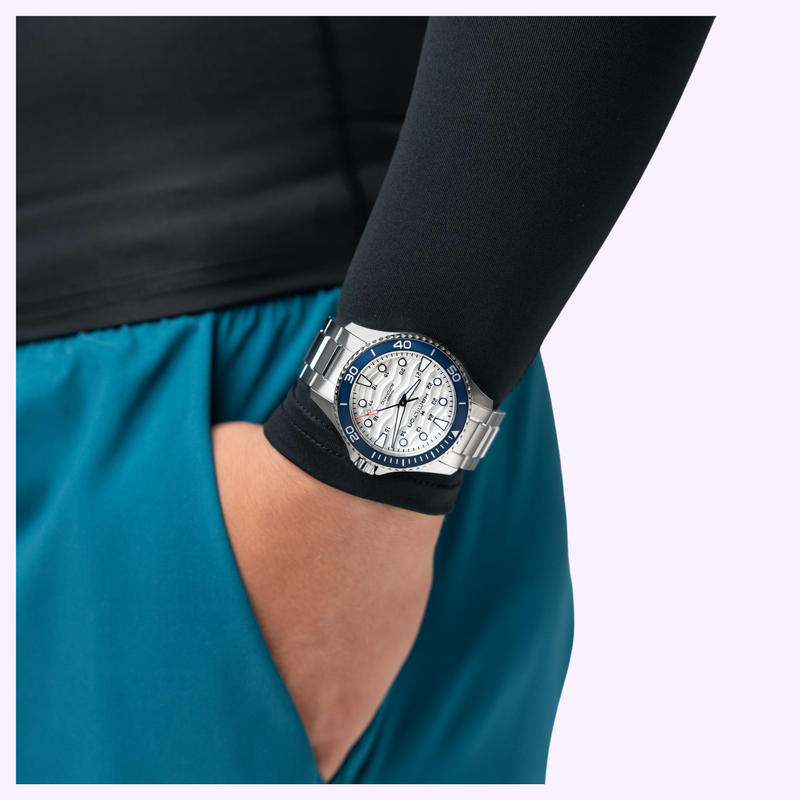
The stainless steel bracelet and white dial pairing move easily between poolside and business-casual settings.
The white wave-textured dial on the H82425110 is a deliberate departure from the black and blue dials that dominate the dive-watch category, and it's a big part of what makes this reference so wearable in a warm-weather market like South Florida. With swim trunks or board shorts, it reads as genuine beach gear. With linen trousers and a short-sleeve shirt, the polish on the stainless steel bracelet elevates it past sport-watch territory into business-casual appropriate. Because the 20mm lug width accepts standard aftermarket straps, you can also swap onto a navy NATO strap for a more relaxed off-duty look, or a tan leather strap to push the watch toward dressier evening wear, without touching the movement.
A few basic care habits will also keep the watch running accurately for years. Rinse the case and bracelet with fresh water after saltwater or chlorine exposure to prevent mineral buildup around the crown and bracelet links, and always confirm the crown is fully screwed down before swimming. Because the H-10 caliber displays a date function, it's best to avoid adjusting the date between roughly 9 p.m. and 3 a.m., when the date-change mechanism is mid-cycle. Like any mechanical watch, a full service every five to seven years through an authorized Hamilton service center will keep the movement running to its original accuracy specification over the long term.
Common Myths About the Khaki Navy Scuba, Debunked
Myth: "Scuba" in the name means it's certified for diving. As covered above, the 40mm version is not ISO 6425 certified and Hamilton doesn't market it for scuba use. The name refers to the design language and heritage, not a certification.
Myth: All Khaki Navy Scuba watches share the same specs. They don't — bezel material, case size, and water resistance all change meaningfully between the 40mm and 43mm versions, so it's worth checking the exact reference number before buying rather than assuming every "Khaki Navy Scuba" listing is identical.
Myth: A 40mm case is too small for a dive-style watch. This is largely a matter of personal preference and wrist size rather than a functional limitation. Owners with wrists under 7 inches consistently report the 40mm case wearing more comfortably than the brand's larger 42-43mm references, and the case still comfortably fits the proportions expected of a dive-inspired sport watch.
Myth: An 80-hour power reserve means the watch never needs winding. It significantly reduces how often you need to wear or wind the watch compared to a standard 40-hour automatic, but it will still stop and need resetting if left unworn for more than three to four days.
Featured Product
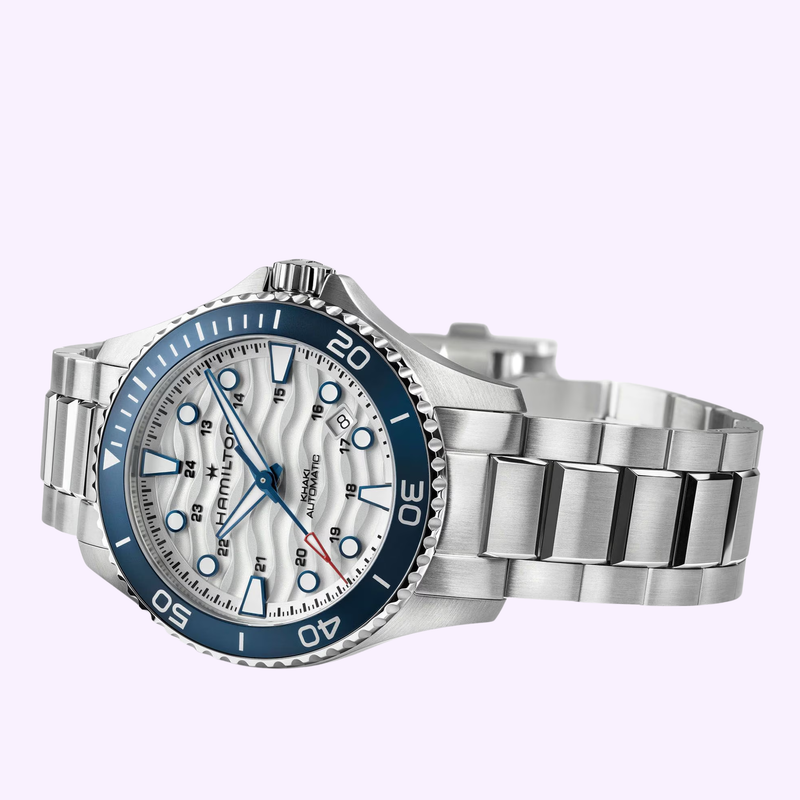
Hamilton Khaki Navy Scuba Auto 40mm H82425110
$975.00
Swiss automatic H-10 movement, 80-hour power reserve, Nivachron balance spring, 100m water resistance, and a lacquered white wave-textured dial on a stainless steel bracelet. Sold new and 100% authentic through Lexor Miami, an authorized Hamilton dealer.
Shop This Watch — $975Why Buy Through Lexor Miami?
Buying a Swiss automatic watch online carries real risk when the seller isn't authorized — grey-market pieces can arrive with tampered serial numbers, voided warranties, or zero manufacturer support. Lexor Miami is listed directly on Hamilton's own official store locator as an authorized dealer, meaning every H82425110 sold here carries full manufacturer backing, alongside free shipping within the 48 contiguous United States on orders over $150, and a 30-day return window with a prepaid return label. With a physical showroom in Miami, more than two decades in the luxury watch business, and thousands of five-star Google reviews, Lexor Miami removes the two biggest hesitations buyers have when purchasing a luxury watch online: authenticity and return flexibility.
Every Hamilton purchased through Lexor Miami also ships in its original manufacturer packaging with full documentation, and questions before you buy can be answered directly by a watch specialist rather than a generic support queue, whether by phone, email, or WhatsApp. For a purchase in this price range, that level of pre- and post-sale support is worth as much as the specs on the page — it's the difference between buying a watch and buying confidence in that watch for years of ownership.
Ready to Add the Hamilton Khaki Navy Scuba to Your Collection?
Authorized dealer pricing, free shipping, and a 30-day return window on every order.
Shop the Hamilton H82425110 NowFinal Thoughts: Which Hamilton Khaki Navy Scuba Is Right for You?
There's no single "best" answer here — only the right watch for how you'll actually use it. To recap the decision points covered in this guide:
- Choose the 40mm H82425110 if you want the most versatile, comfortable daily-wear option with a Swiss automatic movement, 80-hour power reserve, and genuine 100m water resistance for swimming and everyday water exposure.
- Choose the 43mm ceramic version if you want maximum water resistance (300m) and a bolder, more traditional dive-watch presence, and don't mind the added size and weight.
- Choose the Tissot Seastar 1000 Powermatic 80 if raw water-resistance numbers and a lower price point matter more to you than the Hamilton's dial character and brand story.
- Choose a Seiko Prospex SPB if you specifically want ISO 6425 dive certification and proven Japanese dive-watch heritage at a comparable price.
- Choose the Hamilton over both if you want Swiss Made manufacturing, the Nivachron anti-magnetic advantage, and a distinctive design language that stands apart from the watches already in your collection.
For most American buyers researching this exact watch — people who want a genuinely capable, good-looking automatic for beach days, boat trips, and everyday wear rather than technical diving — the 40mm Hamilton Khaki Navy Scuba Auto H82425110 remains one of the strongest values in its price bracket.
Frequently Asked Questions
Is the Hamilton Khaki Navy Scuba 40mm a real dive watch?
No, not in the certified sense. It is not ISO 6425 certified and Hamilton does not recommend it for scuba diving, despite "Scuba" appearing in the name. With 100m water resistance and a screw-down crown, it's well suited to swimming, snorkeling, and everyday water exposure.
What's the difference between the 40mm and 43mm Khaki Navy Scuba?
The 40mm uses an aluminum bezel and is rated to 100m water resistance, while the larger 43mm version uses a ceramic bezel and is rated to 300m. Both share the same H-10 movement and 80-hour power reserve; the main trade-off is size, weight, and depth rating.
How does the Hamilton compare to the Tissot Seastar 1000?
Both use 80-hour Powermatic-family movements with Nivachron balance springs. The Tissot Seastar 1000 40mm offers 300m water resistance at a lower price, while the Hamilton offers a more distinctive wave-textured dial and Hamilton's American heritage branding at a slightly higher price.
How does the Hamilton compare to a Seiko Prospex diver?
Seiko's Prospex SPB watches typically offer ISO 6425 dive certification and 200m water resistance using the 6R35 movement, while the Hamilton offers a Swiss-made movement, a longer 80-hour power reserve, and a Nivachron anti-magnetic spring that Seiko's 6R35 does not include.
How long does the Hamilton H-10 movement run without being worn?
Up to 80 hours, meaning the watch can sit unworn over a long weekend and still be running, and reasonably accurate, when you pick it back up.
Is Lexor Miami an authorized Hamilton dealer?
Yes. Lexor Miami is listed on Hamilton's official store locator as an authorized dealer, and every watch sold is brand new and 100% authentic, backed by the manufacturer's warranty, with free shipping and a 30-day return window.


